
Last calendar year, an extensive study on ventilation in lactating Holstein cows was completed at the University of Wisconsin–Madison (USA) by the research group The Dairyland Initiative. The report was recently published in the Journal of Dairy Science. Since many of you still regularly ask us about installing ventilation/fans in new-build or renovation projects, we have taken the liberty of briefly summarizing the design, results, and conclusions of this remarkable study. In addition, during our USA study tour last summer, our group was able to see the new ventilation techniques that fit perfectly with the results of this study. Further on in this update, you will read what, according to this study, is the most efficient and economical approach to ventilating lactating and dry Holsteins.
General
In recent years, there has been a clear trend in Western Europe toward supplementary mechanical ventilation for lactating cows and also, though still to a lesser extent today, for dry cows. The driver behind this is the assumption that heat stress causes an economic loss of around €100 to €140 per lactating cow per year. For dry cows, an economic loss of around €100 per cow per year is assumed. This would mean that heat stress, after mastitis and hoof problems, would rank in the top 3 economic loss factors if not managed, or not managed properly. Remarkably, this assumed loss is incurred during an average of 50% to 60% of the year. As is well known, many previous studies have shown that the use of mechanical ventilation, possibly combined with sprinklers at the feed fence (so-called “soakers”), helps reduce the negative effects of heat stress, namely lower daily production and declining dry matter intake. However, until now, no study had provided insight into the effect of mechanical ventilation on the lying behavior of lactating cows during weather conditions that cause heat stress. The study we describe below, however, gives us clear insight.
In the trial design, 3 groups of lactating cows at the same production level were monitored continuously:
- Control group: no mechanical ventilation (switched off)
- Group 1: mechanical ventilation with a wind speed of 0.5 m/s (50 cm above the cubicle bed surface)
- Group 2: mechanical ventilation with a wind speed of 0.8 m/s (50 cm above the cubicle bed surface)
Focus of the study
All measurements carried out at the different ventilation speeds focused mainly on gaining insight into the development of lying times (how long do cows lie down per lying bout?) and lying frequency (how many lying bouts per 24 hours?). We know from previous research that cows lie down up to 3.3 hours less per day during periods of heat stress. While lying, the cow's body temperature rises (by 0.8 °C on average). In hot periods, cows respond to heat stress by shortening almost every lying bout and standing up sooner. The reason is that this frees up body surface (the belly area) as additional heat-exchange surface to dissipate excess heat. This is combined with an increase in the number of breaths per minute. We already see this happening once a THI index of around 68 is reached. See the table below.
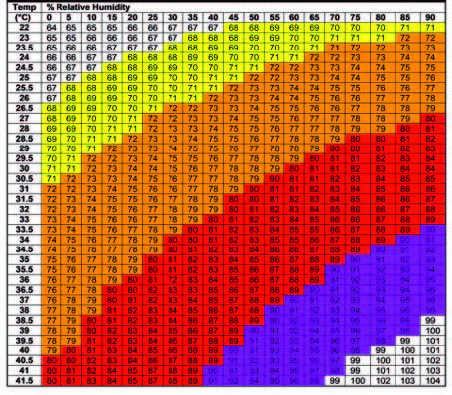
THI = Temperature Humidity Index (a calculated combination of temperature and relative humidity)

“So it is not the case, as many think, that cows lie down more during periods of heat stress and therefore take in less dry matter. The opposite is true, and proven.”
What are the “hidden” adverse effects of shorter lying times and lower lying frequencies?
It goes without saying that shorter lying times, and therefore longer standing periods, take a toll on hoof health, even more so on farms with high overstocking rates. Especially at the end of summer, when cows have been through a considerable period of heat stress, this becomes clear and is repeatedly observed when evaluating locomotion scores and during hoof trimming. The indirect economic damage of these side effects is currently hard to estimate, as they are not yet included in calculation models. This clearly shows that professional and efficient ventilation deserves more than our attention today!
“During periods of heat stress, cows lie down significantly less when ventilation is lacking.”
It is also important to point out right away that installing sprinklers at the feed fence helps cows control their body temperature, provided there is sufficient ventilation at the feed fence! If there is no ventilation, despite sprinkling, the respiration rate does not drop and cows again spend less time lying down. Sprinkling at the feed fence alone clearly does not result in extra lying time or lying frequency.
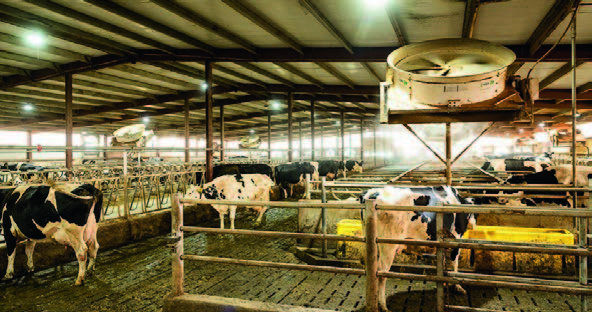
“Without ventilation, the respiration rate does not drop.”
So is it useful and smart to wet cows on the cubicle bed while they are lying down?
When ventilation systems were installed in combination with fans, sprinklers were (and sometimes still are) installed not only at the feed fence but also above the cubicles. The idea was/is to give cows extra cooling while lying down and thus extend lying times. However, research clearly shows that this has negative effects on udder health due to the wetter lying surface. With the growing use of separated manure (solid fraction) as bedding, this is also undesirable, as the DM content of these solids is already an issue in itself. During the visits on our study tour, farm managers also gave us this clear message: “No wetting above the cubicles, for optimal udder health”.
Comparative research also clearly shows that waterbed mattresses have the most negative impact in terms of shortened lying times during periods of heat stress, and these farms need to pay extra attention to their ventilation protocol in heat stress management.
“Farms with waterbed mattresses need to pay extra attention to their ventilation protocol in heat stress management.”
Measurement results for 3 different ventilation regimes
Below are the comparison charts for the various measured values:
- A: Daily maximum vaginal temperature
- B: Daily lying time: on average 13 hours per day without heat stress
- C: Lying bouts per day: on average 11 bouts per day without heat stress
- D: Duration per lying bout: on average 95 minutes without heat stress
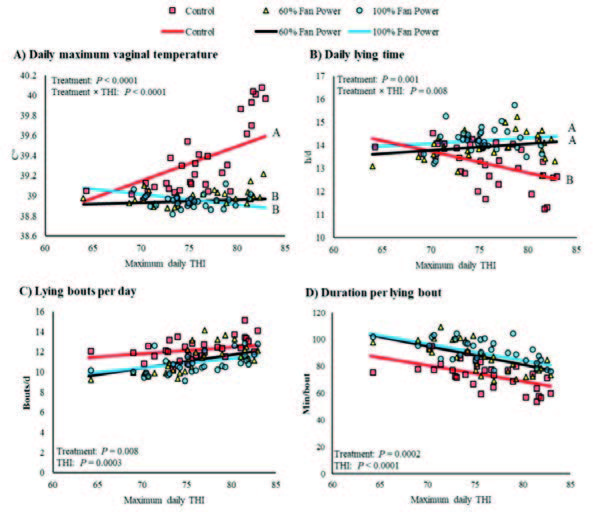
Legend:
- Control = no mechanical ventilation (fans switched off)
- 60% Fan Power = 0.5 m/s wind speed (1.8 km/h)
- 100% Fan Power = 1 m/s wind speed (3.6 km/h)
Initial conclusion(s):
Body temperature (vaginal):
- With mechanical ventilation at a wind speed of 1.8 km/h or more, cows are very well supported in managing their body temperature as soon as the THI rises above 68.
- At a wind speed of 3.6 km/h, this is even better.
- By comparison, cows without ventilation have a very hard time and quickly increase their respiration rate, the so-called “panters”, with all the adverse consequences.
By comparison, cows without ventilation have a very hard time and quickly increase their respiration rate, the so-called “panters”, with all the adverse consequences.
Daily lying time:
- In cows without ventilation at a THI above 68, we see daily lying time shortened by around 2 hours/day.
- In mechanically ventilated cows, we see a stable to slightly increased daily lying time pattern, at both 1.8 and 3.6 km/h wind speed.
- o 3.6 km/h gives a slightly more positive and the best result here.
Number of lying bouts per day combined with the duration of the lying bouts:
- Mechanically ventilated cows, whether at 1.8 or 3.6 km/h, have fewer separate lying bouts than cows without ventilation from THI 65.
- The reason, looking at chart D, is that the duration per lying bout in mechanically ventilated cows is on average almost 15 minutes longer than in cows without mechanical ventilation.
- Mechanically ventilated cows therefore show a much more efficient, comfortable, and healthy 24-hour lying pattern.
And what is the impact on milk production and dry matter intake?
Milk production:
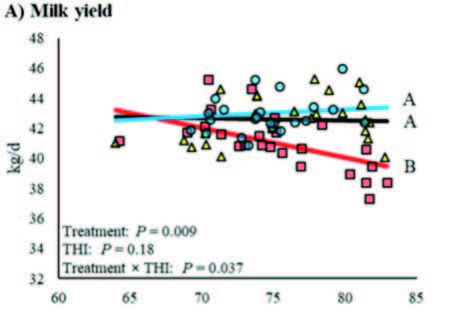
- The control group (not mechanically ventilated) loses around 2 kg of daily production per cow for every 10-point rise in THI. Very confronting figures!
- Cows mechanically ventilated at 1.8 km/h lose only 0.2 kg/day per 10-point rise in THI.
- Cows ventilated at 3.6 km/h recorded a slight increase of 0.5 kg/day per 10-point rise in THI.
Dry matter intake:
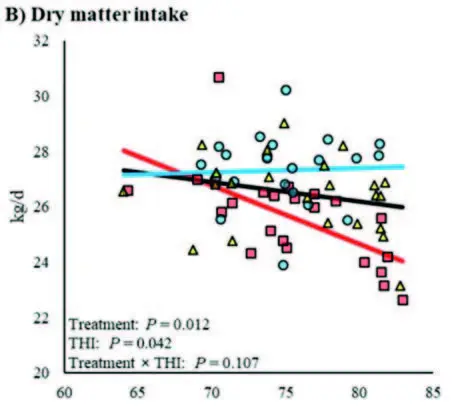
- In the control group (not mechanically ventilated), DM intake drops by as much as 0.9 kg/cow/day per 10-point rise in the THI index. Huge losses, then.
- In the group mechanically ventilated at 1.8 km/h, we see a drop of 0.33 kg DM/cow/day per 10-point rise in THI.
- In the group mechanically ventilated at 1.8 km/h, we see a drop of 0.33 kg DM/cow/day per 10-point rise in THI.
In detail:
- A wind speed of 1.8 km/h gives on average 0.9 kg higher DM intake/cow/day than without mechanical ventilation
- A wind speed of 3.6 km/h gives on average 1.7 kg higher DM intake/cow/day than without mechanical ventilation
Example: a 250-cow farm that loses 0.8 kg DM intake/cow/day during periods of heat stress, at a feed conversion rate of 1.45, misses 1.15 liters of production per day × 250 cows = 287 liters of lost milk/day.
- Now decide for yourself how many days of heat stress you think your herd experiences, but over the past 4 years we had (calculated on RMI data) an average of 92 days/year with a THI above 68. Yes, you read that right: almost 25% of the year, or an average of €12,000 (milk price 45 cents/kg) of lost milk per year over the past 4 years if you ventilate insufficiently or not at all. That is an average loss of €48 per lactating cow per year.
- And this does not yet take into account losses from increased hoof problems and declining fertility.
General CONCLUSIONS:
“At a ventilation speed of 3.6 km/h at cubicle height, we see a production increase of 0.5 kg/cow/day.”
✔️ This is the first study to clearly show that if we want to manage the lying times of lactating cows in warm weather for maximum economic benefit, we need wind speeds of 2.5 to 3.5 km/h at 50 cm above the cubicle bed surface.
✔️ By applying this mechanical ventilation protocol, we increase cow comfort for lactating animals, as confirmed by:
- Lower vaginal temperatures in ventilated cows vs. non-ventilated cows
- No to very slightly increased respiration rate in ventilated cows vs. non-ventilated cows
- Longer lying times in ventilated cows vs. non-ventilated cows
- Considerably higher DM intake in ventilated cows vs. non-ventilated cows
- Higher production/cow/day in ventilated cows vs. non-ventilated cows
✔️ So choose fans or ventilation systems for your barn or milking area that can reliably achieve ventilation speeds of 2.5 to 3.5 km/h at 50 cm above the cubicle bed, and base your choice of fans and their locations on meeting these standards.
✔️ For energy efficiency and maximum cost savings, it is worth looking into drive motors equipped with the new Turntide technology. In recent independent comparison tests, these motors used up to 60% less electricity than conventional drive motors. Also choose frequency drives that are protected against stray voltage. Pay particular attention to this for connections around your AMS or conventional milking systems.
✔️ Don't forget to equip your holding area, milking parlor, or AMS areas individually. This can have a hugely positive effect on AMS visit frequency and on cows' willingness to enter the milking parlor in warmer periods.
✔️ Two projects with the new ventilation principles using exhaust fans (equipped with Turntide) are currently being installed in Flanders. This new technique offers significant advantages in ventilation quality, ergonomics, maintenance, and above all cost control. As soon as they are finished, we will share images in one of our next updates.
“Good ventilation pays off!”
✔️ Make use of the winter period. It is a good (somewhat quieter) time to rethink your ventilation and discuss it with the relevant parties. You now have time to think it through properly, do the calculations and, if necessary, go and see examples. Make sure you are ready this summer, because good ventilation pays off.
Good luck, and see you soon, Filip Jamart | XL-PRO Milking.