
This recent outbreak in Germany is not only causing nervousness among dairy farmers in Europe; processors and traders are also following developments closely.
Is the risk contained? The answer is and remains uncertain. So far, it appears that the infected area (in Brandenburg) has been isolated and that the outbreak was nipped in the bud. The affected area produces very little milk, and only two dairy farms are located within the 10-kilometer perimeter. However, vigilance remains essential.
“So far, it appears that the infected area has been isolated.”
Under current weather conditions, the pathogen can easily survive in the environment for several months and spread very easily via the wind. The question today is to what extent the classic measures, with a three-kilometer exclusion zone and a ten-kilometer surveillance zone, are sufficient. We hope for the best. Our advice: stay very alert now with regard to your biosecurity protocols for farm visitors. Disinfection before and after each visit is a must!
Positive price developments
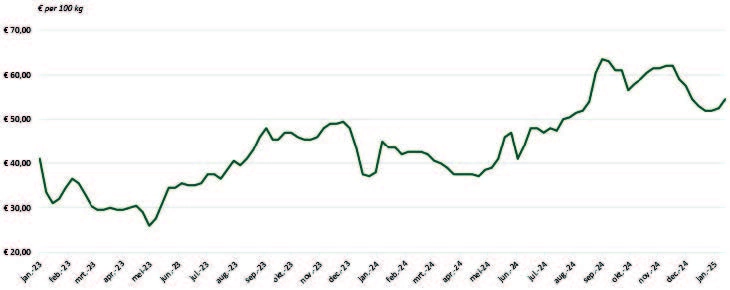
If we leave FMD aside and look purely at physical dairy price formation, 2025 has not started badly. The milk price remains firmly in the saddle, mainly because milk processors are keen to buy your milk (we have discussed this several times in previous newsletters). Over the last 12 months, they have been willing to pay a good, competitive price. The spot milk price also remains firm and rose again in the first weeks of 2025 (figure 1).
Source: DCA (www.nieuweoogst.nl)
Dairy processors can only justify and pay high milk prices if they can generate sufficient returns on their processed products. The market for various dairy products can still be described as good, without question. The historically high prices for milk fat (butter, cream, AMF) are striking. These high prices are caused by a global shortage of milk fat.
“The daily chatter from the buyers' street.”
In recent years, butter prices have developed in a way no one would have dared to predict. This trend was supported by a more positive image of butter, boosted in part by the popularity of cooking shows on television and social media. This has led to a steady but sure increase in butter consumption.
At the same time, the availability of milk fat is declining, not only because of lagging milk supply, but also because a lot of fat goes into the equally strong cheese market.
Our partners at the Dutch research firm Dairyntel recently published an interesting analysis on this. You will find the report attached to this newsletter. As an entrepreneurial dairy farmer, please take the time to read it. You will see and learn that “the daily chatter from the buyers' street” is not the reason for the milk price increases. The report's findings clearly show that we are living in a fascinating price-formation market today.
High milk prices and low costs
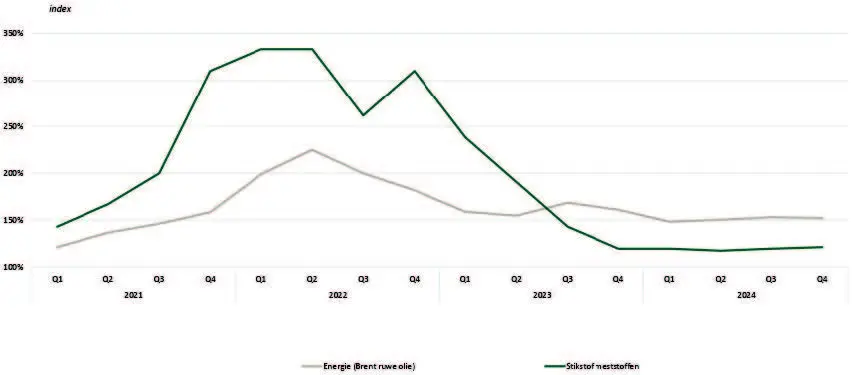
At the end of 2022, milk prices reached record highs around the €0.60 per liter mark. A pleasant and more than welcome development, given the rise in the critical break-even price at farm level. Currently, paid-out milk prices are close to the record levels of 2022, while energy and fertilizer costs at farm level are considerably lower (figure 2).
Source: Dairyntel analysis
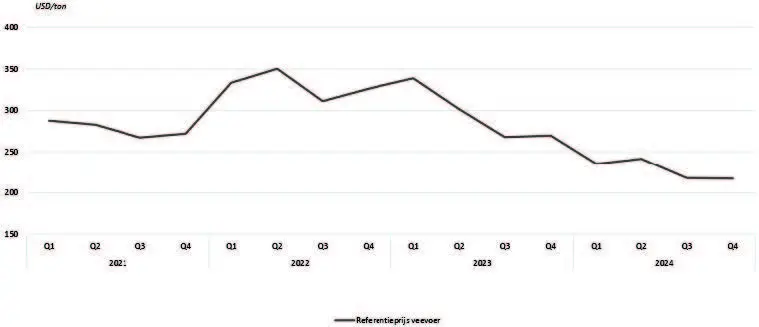
Feed costs have also fallen sharply compared with 2022 (figure 3).
Source: Dairyntel analysis (Global benchmark feed price for corn and soy)
“So it is not the case, as many think, that cows lie down more during periods of heat stress and therefore take in less dry matter. The opposite is true, and proven.”
“So the wind is currently blowing hard in the price sail.” We won't descend into negative polemics, but this price level is not without risks. Several milk processors were barely able, if at all, to close 2023 with a positive result, because the hunt for milk required a milk price that could barely, if at all, be recovered from the market. In this competitive market, the paid-out milk prices of individual processors will, because of their chosen product-market combination, more often than before be out of line with the sales value of the end product. “Price elasticity”, as it is often called, is now running up against limiting factors. “Premium products” are doing well, but positioning now makes the difference.
“'Premium products' are doing well.”
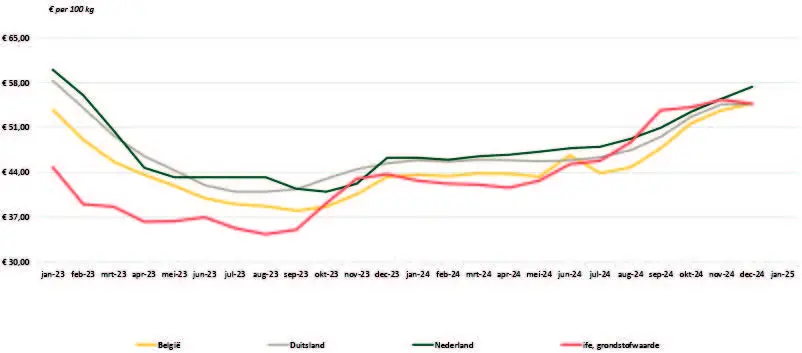
This is clearly reflected in figure 4, where the raw material value (as calculated by ife, the Institut für Ernährung und Ernährungswirtschaft e.V.) was below the milk prices paid out in Belgium, Germany, and the Netherlands for almost the whole of 2023. This pattern also continued during the first half of 2024.
Source: Milk Market Observatory, Institut für Ernährungswirtschaft (ife, Kiel)
Time to put our feet up?
So it remains a real challenge for milk processors to keep paying these higher milk prices, but even though the raw material value fell again at the end of 2024 (figure 4), the outlook for 2025 is favorable, mainly because of cost developments.
To conclude, let's take a quick look at China, one of the most important export destinations for dairy in recent years and therefore an important factor in the global balance between milk supply and demand.
Global exports to this country reached a record in 2021. Due to the COVID-19 pandemic and a sharp increase in self-sufficiency, China's import needs have since fallen considerably. This annual decline went hand in hand with a decreasing volume of milk available for export in the traditional exporting regions of the EU, the US, and Oceania.
Because both developments ran in parallel, prices remained high. There are now signs that the local milk balance in China is also changing (due to extremely high roughage prices) and it is not a given that imports will weaken further. Both local milk production and local dairy consumption (falling purchasing power) are developing weakly. The question seems to be: which of the two will be weakest in 2025 and ultimately determine in which direction China's import needs will move next year?
“Both local milk production and local dairy consumption are developing weakly.”
Milk production trends in the EU?
Do current developments encourage dairy farmers to milk considerably more? Clearly, the aging profile of our European milk producers will not be the driver of this today, certainly not in Western, Southern and Central Europe. For young, modern dairy farmers, increasing daily income over feed costs is now more interesting than ever.
The pressing question: how much more milk can (and will) actually be produced in the EU, taking into account the environmental and sustainability targets currently laid down by law? In short: 2025 will again bring many uncertainties to be resolved, and it will undoubtedly be another remarkable year. In terms of milk price, the first half at least looks almost certain to be positive. So the message is: milk hard.
Filip Jamart | XL-PRO Milking.