
During last week's follow-up evaluation, it became clear that the farms combining soaking with the right ventilation strategy were the ones that recorded the smallest production drops during the heatwave a week earlier.
Many farmers are now trying to apply water as the days get warmer. However, stay alert: factors such as droplet size, sprinkling cycle, and air speed are now key to the effective evaporative cooling you are aiming for.
Besides shade and sufficient drinking water, active cooling with water and air — known as “soaking” — is one of the most effective measures. However, the effectiveness of a soaking system depends heavily
on two technical parameters: the size of the water droplets and the air speed at which the water then evaporates.
1. Droplet size: coarse water, not mist
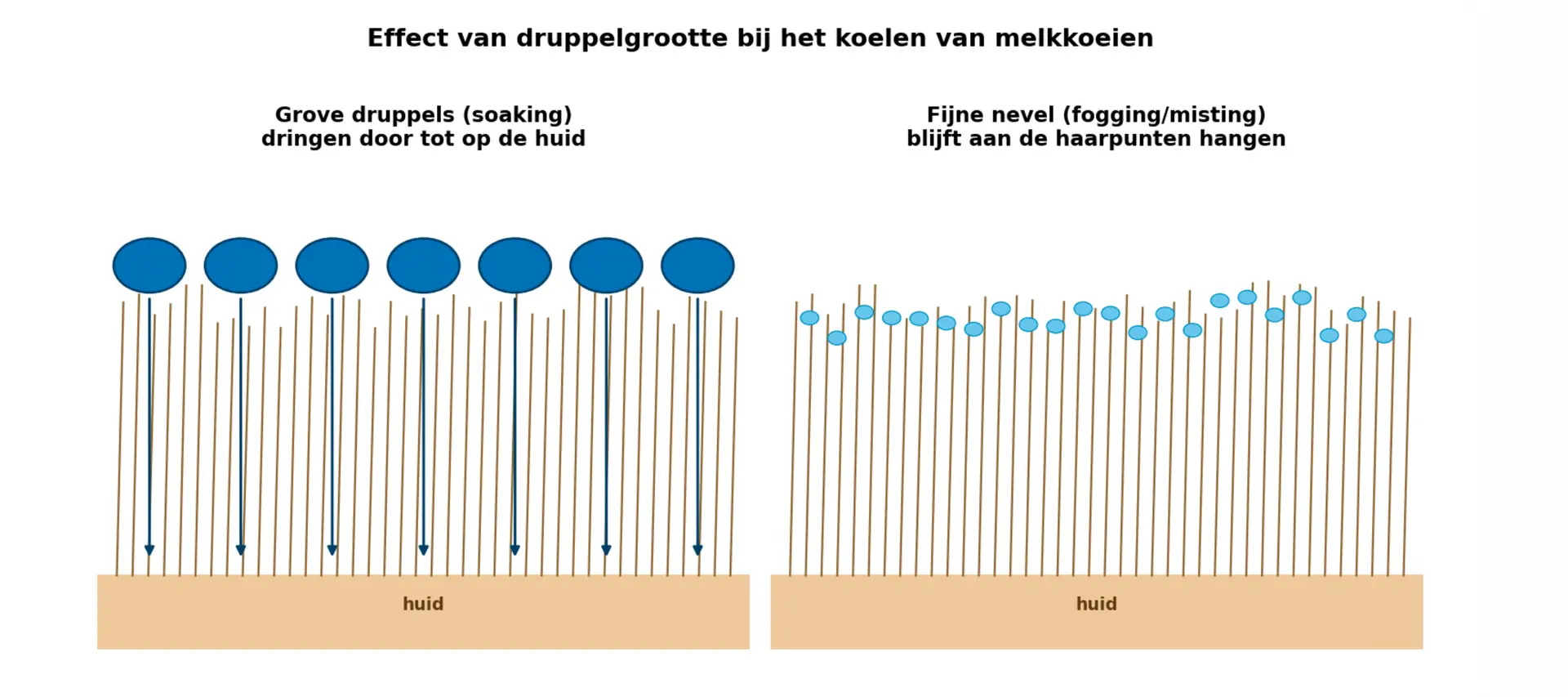
Water cooling works through evaporation: every liter of water that evaporates draws a considerable amount of heat from the cow's body. However, this only works if the water first reaches the cow's skin and actually comes into contact with it. Coarse droplets penetrate the coat and wet the skin – this is the principle of soaking, or “direct evaporative cooling”.
Fine mist (fogging/misting), on the other hand, mostly stays on the tips of the hair: it forms an insulating layer of tiny droplets that does not reach the skin and, during periods of high relative humidity, actually increases the humidity in the barn without effectively cooling the cow.
Fogging systems are therefore mainly suited to dry climates, where the fine droplets evaporate in the air itself and cool the surrounding air (indirect cooling).
2. Research findings: droplet size and cooling effect
A Chinese study (Li et al., 2019, Energies) examined the relationship between droplet diameter and heat transfer, supplemented by a field trial. Eighteen different average spray droplet diameters (ADSD, 0.3 to over 1.5 mm) were generated using six nozzles at three pressures and two wind speeds.
Under laboratory conditions, heat transfer peaked at an ADSD of about 0.91 to 1.0 mm; with larger droplets, heat transfer decreased again because the water no longer forms an even water film and tends to run off along the flank.
The field trial confirmed this: at an optimal ADSD of 0.947 mm, the cows' respiration rate dropped by an average of 4.2 breaths per minute, compared with only 2.1 breaths per minute with coarser droplets of 1.127 mm. In addition, the system with the smaller, optimal droplet used 22.9% less water to achieve the same or a better cooling effect.

An American study in a hot, dry climate (Chen et al., 2015, Journal of Dairy Science) adds nuance to this picture. In 19 high-producing Holsteins that were each sprayed for 3 minutes with coarse nozzle droplets, droplet size within the tested (coarse) range had no demonstrable effect on cooling: the flow rate (the amount of water per minute) determined the result. A flow rate of 1.3 liters per minute or more was enough for a noticeable cooling effect; higher flow rates provided only limited additional improvement.
In summary: the biggest gain in cooling efficiency comes from switching from fine mist to coarse droplets that penetrate to the skin.
Within that coarse range, an average diameter of around 0.9 to 1.0 mm appears to offer the best balance between heat transfer and water use; above about 1.1 mm, larger droplets mainly cause water loss through run-off, and the final cooling effect is determined more by the amount of water applied per minute (flow rate) and the air speed for evaporation than by the droplet diameter itself.
3. The wet-dry cycle and the role of ventilation
Soaking systems work on a “wet-dry” cycle: short, intensive sprinkling with coarse droplets, followed by a longer ventilation period during which the water can evaporate from the skin. In practice, this usually means 1 to 3 minutes of sprinkling, followed by 5 to 15 minutes of ventilation, after which the cycle repeats. Without enough air movement, the cow simply stays wet and hot – so the fan is not an add-on, but an essential part of the cooling system.
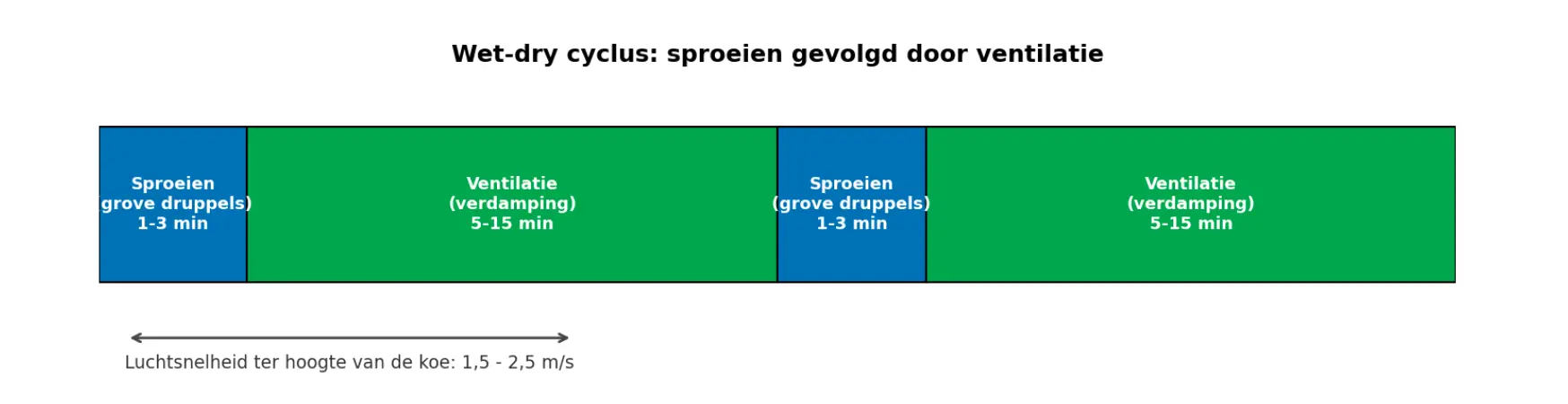
For a noticeable cooling effect, an air speed of about 1.5 to 2.5 m/s at the level of the lying or feeding cow is recommended. Fans with a diameter of 90 to 130 cm are most commonly used for this; when placed in a row, they should be no more than 8 times their diameter apart, and side by side no more than 2 to 3 times their diameter. Unfortunately, what we see all too often here in Flanders is that circulation fans have been installed where pressure or exhaust fans should have been. On these farms, we now see that wind speeds of 2.5 m/s are often not reached.
4. Practical considerations
- Use low-pressure nozzles (approx. 0.7 to 1.4 bar) that produce a coarse, targeted spray with a droplet diameter of about 0.9 to 1.0 mm – not high-pressure misters.
- Ensure sufficient flow rate (guideline: 1.3 l/min per animal or more); this matters at least as much as the exact droplet size. Also make sure you have enough water in reserve, and be careful not to put the cows' drinking water supply at risk.
- DID YOU KNOW: Last week, a study was published in the Journal of Dairy Science mapping the relationship between the THI index and water consumption. Once the THI index rises above 68, water consumption increases by 1.5 liters per cow per day. This means that with a THI increase of, for example, 20 points, a barn with 300 lactating cows has an EXTRA water requirement of 9,000 liters per day!
Is your water supply system adapted to this today?
- Place sprinklers and fans above the feed alley or holding area, where cows stand still long enough to complete the cycle.
- Ensure adequate drainage: soaking requires considerably more water than fogging, and the floor must drain quickly to avoid wet, dirty walkways. Failing to do so can have a negative impact on udder health.
- Start the system from a THI of 68, which often means at temperatures of 22–24 °C combined with high humidity, and not only in extreme heat. Starting in time prevents a great deal of stress in the animals.
5. How to measure ventilation speed properly – simply and correctly
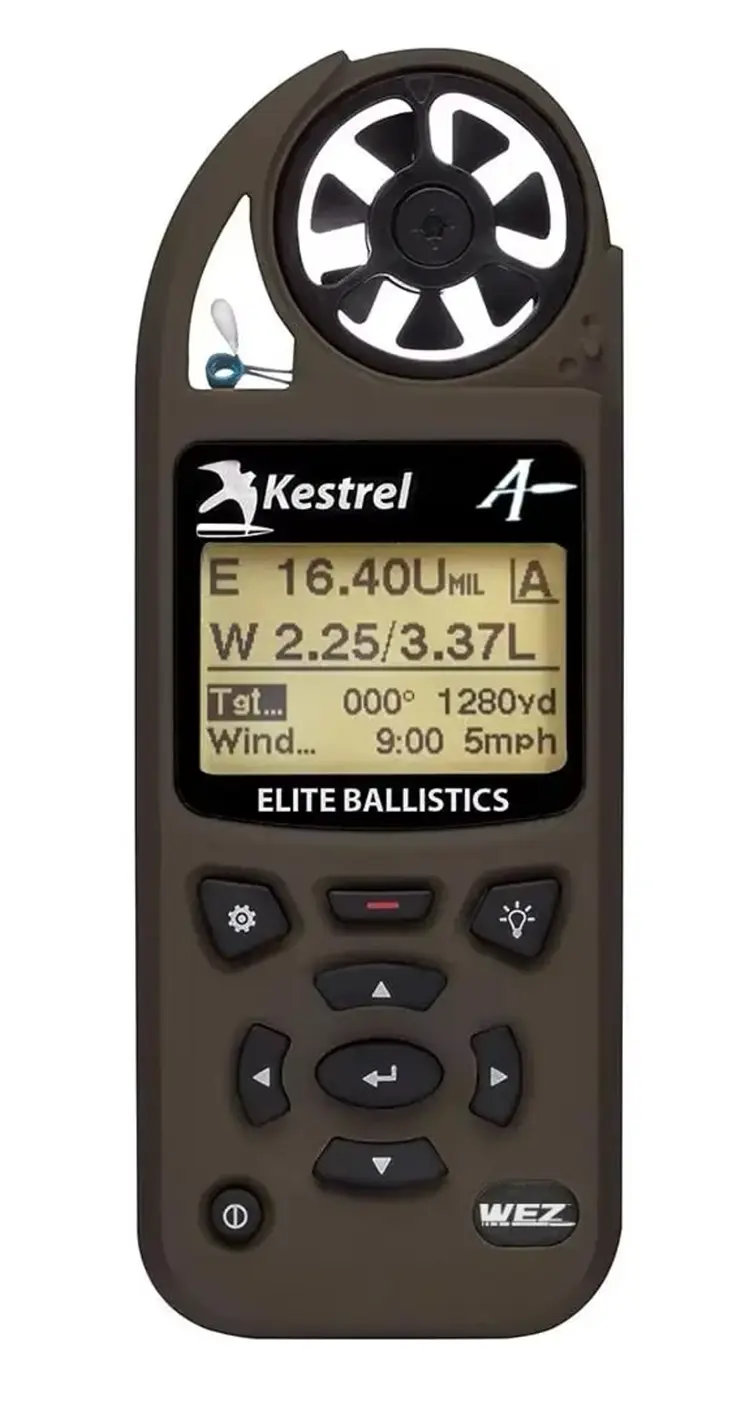
Tip: measure correctly with an anemometer
Make sure you have a handheld anemometer that you can use at any location in the barn. We use the Kestrel meter: very high quality, reliable, and easy to use. Available everywhere online.
6. Cooling in the milking parlor
The photo at the top of this newsletter was sent to us by one of our customers in Antwerp, who chooses to cool cows in the milking parlor with water and ventilation. The reason is that he does not want soaking at the feed fence near the cubicles, because the cubicles are bedded with the solid fraction of separated manure. Certainly not unwise.
This system is also widely used in Spain, but then in the AMS box.
Good luck, and see you soon,
Filip – Cedric and Ignace Jamart | XL-PRO Milking.