Dear all,
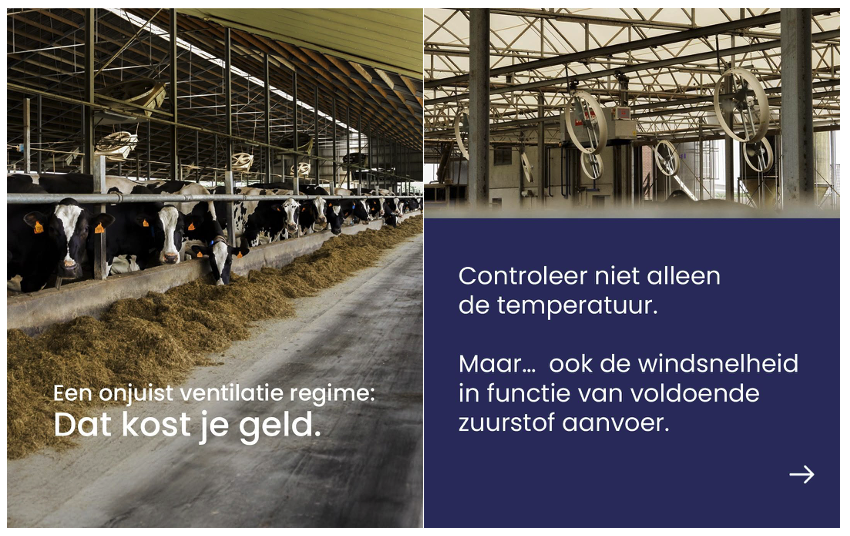
Last week's heat will not easily be forgotten. Above, I deliberately included 2 images from our newsletter of May 21, in which we focused on the importance of properly preparing your summer ventilation protocol and on which measures are essential during extreme heat. At the time, some people in the supply industry did not really take it seriously; today, they think differently.
1. Evaluation: what has this heat (wave) actually done to the cows?
A 6-day heatwave with little cooling at night is extremely demanding for both lactating and dry Holsteins. Cows start to experience heat stress from around 19 to 22 °C, depending on the humidity at that particular moment. As you have seen for yourselves, with daytime temperatures above 30 °C and no cooling at night, the cow's body has little to no chance to recover. For 6 days, the THI index averaged well into the 80s and humidity climbed to 95% in Uccle and Kleine Brogel.
Under normal Western European summer conditions, during warmer periods the cow can regulate her body heat at night through her breathing and cooling via her body surface. She performs her own so-called “thermal heat balance correction”.
When nights stay warm — which was clearly the case during this heatwave — heat stress builds up day after day in the animal, mainly due to the heat combined with very high relative humidity. We don't want to spread panic, but the consequences of this heatwave will not be limited to last week's 6-day hot spell; they will continue for at least another 4 to 6 weeks.

A quick reminder: the Temperature-Humidity Index (THI)
The THI index combines temperature and humidity into a single number and is the standard measure for assessing heat stress in dairy cows. From a THI of around 68, mild heat stress occurs, with an initial drop in feed intake and production. Above THI 72 it is considered moderate, and above THI 80 severe heat stress, with sharp drops in feed intake, production, and fertility. Given the temperatures measured during this heatwave (up to 38–39 °C), the THI on the peak days was well within the severe 80+ zone, especially combined with the equally high relative humidity.

For your information: on Saturday morning, June 27, between 1:00 and 2:00 a.m., 33.7 °C was measured in Kleine Brogel, Belgium, with a relative humidity of 95%, corresponding to a THI of 93 at that moment. Extreme and never-before-seen harsh conditions for Holstein cows in Belgium and the Netherlands!
1.1 Direct consequences (past 6 days)
Sharply reduced dry matter intake
You will mainly have seen roughage intake decline, because digesting fiber-rich feed produces a relatively large amount of metabolic heat. At a THI above 72, cows (unconsciously) adjust their behavior immediately (autoreflex) to avoid that extra heat production.
Drop in production
Typically 10 to 25%, with the biggest losses in high-producing animals, which also produce the most metabolic heat and are therefore the most sensitive. Our customers reported production losses per cow per day ranging from 2 to 9 liters. This variation is strongly correlated with production level and the ventilation system or regime used/set.
Shifts in milk components
Lower fat percentage, often lower protein as well, and fluctuating urea levels due to irregular protein and energy intake.
Behavioral changes
Increased respiration rate (panting) combined with standing “halfway” in the cubicles. The reason cows stand “uphill” with their front legs on the cubicle bed, so-called “perching”, can be explained: they do this to take as much rumen weight as possible off the front of the rib cage, giving the lungs as much room as possible so they can make maximum use of the lung surface. What is often overlooked is that they do this not only because of stress but also out of a need for oxygen. Excessive panting and crowding around water or shaded areas are clear signs that the cow's thermoregulatory system was at its limit (known as “bunching”).
Reduced lying time
During heat, cows lie down less or for shorter periods and deliberately seek out drafts or cooler spots, which puts extra strain on their hooves. You can find more information on this in last year's newsletter (available in the archive on our website).
Increased risk of rumen acidosis
Fluctuating feed intake and reduced rumination disrupt the balance in the rumen and reduce the pH-buffering effect of saliva.
1.2 Delayed consequences to monitor in the coming weeks
Stay alert now: the real and financially significant consequences of a heatwave often only show up 2 to 6 weeks later.
Fertility
Oocytes that were maturing during the heat often have poorer quality now, resulting in poor embryo quality and, above all, increased embryonic mortality. Expect extra repeat breeders 4–6 weeks after inseminations carried out during the heatwave. Consult your veterinarian and/or the person responsible for fertility management now. Adjust the checklists in your software for cows to be checked for pregnancy, and agree together on a re-check of cows confirmed pregnant over the last 4 to 5 weeks. I have seen several times in the US that under extreme heat stress (above 38 °C), embryonic mortality can rise to nearly 20%. The message is: do NOT wait. If you do, it will cost you production and feed efficiency within 8 to 9 months due to the increase in DIM (Days In Milk). Limiting the damage is the task at hand now.
Hoof health
Sole ulcers and (sub)clinical laminitis caused by heat-induced founder (whether or not induced by rumen acidosis) usually only become visible 6–8 weeks later during hoof trimming. Be very alert here as well and mark it in your calendar now. These are insidious, deceptive sole ulcers that become visible very slowly and gradually undermine the cows' mobility. (AMS farmers need to be extra vigilant here.)
Immunity and udder health
Increased risk of mastitis due to reduced general immunity and possibly dirtier lying areas during the hot period. Cows have also often leaked milk because of the stress. Users of soaking in particular are now more vulnerable. Dip extra thoroughly now, or increase the spray time to 0.2 seconds on your AMS for 2 weeks.
Milk production
Give the cows time now, correct where needed, and be patient. Also monitor feed refusals very closely now and avoid overfeeding, given the quality of the ration at the feed fence on these hot days. Above all, be patient: the cows have been (very) severely tested.

2. What to watch out for now and which measures to take if needed?
In the coming weeks, targeted monitoring is just as important as intervening: most of the damage has already been done, but by spotting problems early, further damage (for example, a second wave of repeat breeders, or rumen acidosis from restarting the full ration too quickly) can be avoided.

01. Fertility
Monitor heat detection extra carefully for the next 6–8 weeks, because heat signs after heat stress are often shorter and less pronounced. (for those not using activity-based heat detection)
Expect a lower conception rate for inseminations carried out during or just after the heatwave, and don't be surprised by extra repeat breeders 4 to 6 weeks later.
Consider scheduling pregnancy checks a little earlier in doubtful cases, so that repeat breeders can be re-inseminated quickly instead of losing a full cycle.
02. Ration and rumen function
Restore feed intake gradually — don't switch back abruptly to the full pre-heat ration all at once. Consult your nutritionist weekly now and keep a particular eye on feed efficiency. Feed efficiency is now your guideline for increasing DM in the ration fed.
Check roughage for heating more than usual now, and (where possible – really a MUST) provide enough feeding places so that dominant animals do not push away weaker or more heat-sensitive cows. Overstocked farms have been hit hardest, and the same will apply to the after-effects.
03. Hooves and comfort
Schedule a hoof inspection within the next 6 to 8 weeks, paying particular attention to sole hemorrhages caused by excessive standing during heat stress. If labor allows, try to lift every cow in the trimming chute, spread over 2 weeks. Well inspected = peace of mind and fewer problems.
Check lying comfort and hygiene in the barn; animals that lay down less during the heat now need extra rest to catch up.
This year, we again measured the temperature of the liquid in water beds, on day 6 (Friday, June 26). As a dairy farmer, this is definitely something to think about for future top-level dairy management in a time of changing climate conditions.
Check carefully for “trembling cows” now. These are animals that suffered very badly and may have sustained slight damage to their nervous system. Their hind legs tremble when they stand. Move them to a well-ventilated area with good footing so they can get up easily after lying down.
04. Water
Now too (and in fact ALWAYS), make sure enough fresh, cool drinking water is available — water requirements remain elevated for the first few days after the heatwave while the body recovers. Add extra troughs if you don't have 10 to 12 cm of drinking space per animal.
05. Special attention: youngstock and dry cows
In practice, these groups are often monitored somewhat less closely than lactating animals, but they are at least as much at risk:
Dry cows that experienced heat stress in the last weeks before calving more often give birth to calves with a lower birth weight and a less well-functioning immune system.
Consider paying extra attention during the first weeks after calving to cows that suffered badly from the heat during the dry period.
We often see lower Brix values in the colostrum of fresh cows that experienced extreme heat stress during the dry period.

3. Ventilation and heat management: measures for the future
With the Belgian Royal Meteorological Institute (RMI) forecasting a summer that may be 1 to 2 °C warmer than normal, with a greater chance of hot spells, extra and maximum attention is required. The heatwaves of recent years also show that this is not a one-off exception, but a recurring phenomenon that a dairy farm can (and really MUST) prepare for structurally. Below, we have quickly listed a number of measures, from quick wins to more far-reaching ones, so you can decide which level suits your farm and budget given the current milk price and cash flow.
3.2 Short and medium term (investment in equipment)
With a limited investment in equipment, a considerable reduction in heat stress can often be achieved.
Fans (axial or recirculation)
Place them above the feed fence and the cubicles, aiming for an air speed of at least 2 to 3 m/s at cow level. This is usually the most cost-effective measure.
Sprinkler or misting systems
Combined with fans, misting enhances evaporative cooling and is especially effective in the holding area in front of the milking parlor, where cows stand close together.
3.3 Looking ahead (structural changes to the barn)
When building new or carrying out a major renovation, it is worth making heat management a starting point of the design. The reason is the view of one of our customers, who said yesterday (and we at XL-PRO fully agree):
“With the current and future climate outlook, heat is becoming one of the biggest threats to achieving maximum production and income over feed costs, and therefore to the final financial result.”
Consider a tunnel ventilation system, especially in wider or deeper barns where natural ventilation is insufficient.
If your location allows it, choose a cross-ventilation concept for new builds. We at XL-PRO are big fans of it.
Cross-ventilated barns built to the right design are a paradise for high-producing animals during hot periods. We see hardly any production losses, only 0.5 to 1 liter/cow/day, in these 9
barn systems in the US, which in turn are also warmly welcomed by the government authorities in Belgium (zoning). In Belgium, the first barn built according to this concept will be a reality within about 10 months.
For renovations or existing barns: tune the ventilation system to concrete target values, as shown in the table below:

3.4 Organizational: a heat protocol for the farm
Besides technical measures, a simple action plan agreed in advance often makes the biggest difference — precisely because decisions then no longer have to be made amid the rush and stress of the heatwave itself.
Draw up a simple protocol with concrete triggers, for example: when temperatures above 28 °C are forecast, extra water troughs, adjusted feeding times, and additional fans are deployed automatically.
Define for each animal group which animals are most at risk (high-producing cows, pregnant animals, dry cows) and give them priority when cooling capacity is limited.
Also discuss the action plan with any employees or family members involved in running the farm, so that everyone acts in time and consistently. Here, too, protocol-based management is the key.

3.5 Is it even possible to keep milking hard at temperatures between 35 and 37 degrees Celsius?
The answer is simple: Yes.
Below are last week's results from the top 5 AMS farms in the province of Cantabria, Spain, where temperatures last week ranged from 34 to 38 °C. (Farms with at least 4 AMS units and an average of 55 cows/robot). Talk about efficient milking!
These figures are reported weekly by Berto Sierra.
In particular, tunnel ventilation combined with rain showers and slight understocking keeps the cows at maximum production.

4. In summary
Here is a quick summary of some points to watch in the coming weeks:

The additional CHALLENGE…..
Finally, we at XL-PRO Milking are very curious how the future will develop in terms of nitrogen- and, soon, methane-reducing techniques in relation to heat stress management. The question is which system, within the framework of the emission regulations imposed on Flemish and Dutch livestock farming, will hold the strongest cards in the future in terms of fitting into an efficient and economically sound barn and ventilation system.
40 air changes per hour, at an average air speed of 1.5 to 2 meters per second — as appropriate within an effective heat stress management protocol — combined with creating a barn climate that is friendly to both people and animals while applying ammonia- and, soon, methane-emission reduction techniques, will certainly require some creativity….
Keep a cool head.
See you soon,
Filip, Cedric & Ignace Jamart | XL-PRO Milking